
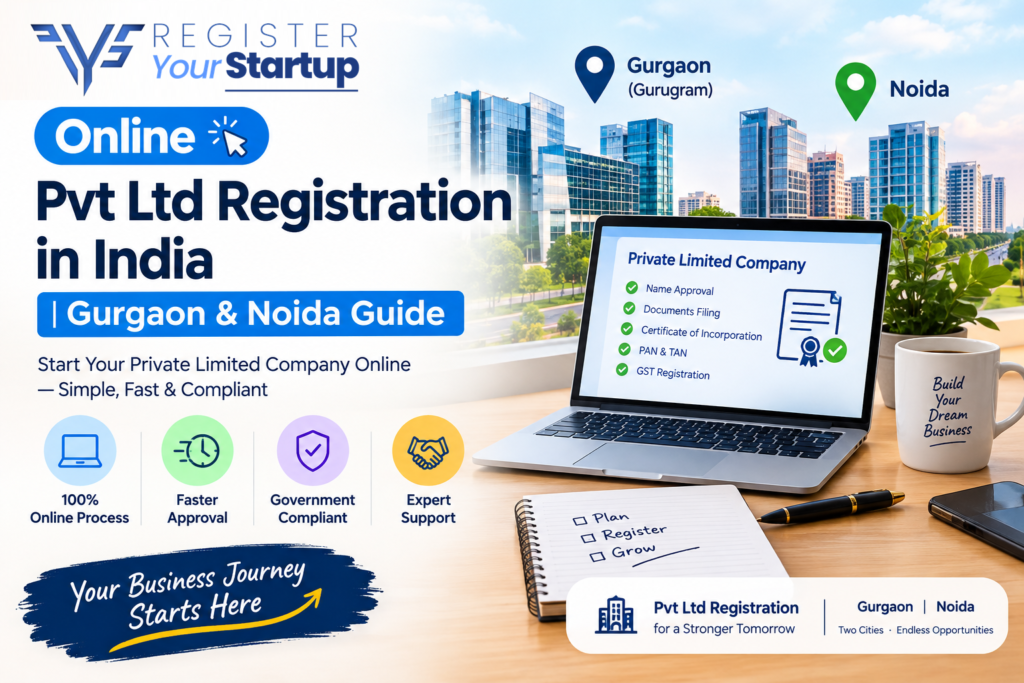
Online Pvt Ltd Registration in India: Step-by-Step Guide for Gurgaon and Noida Founders
India has become one of the most active startup ecosystems in the world, and the Private Limited Company remains the structure of choice for founders who want credibility, limited liability and the ability to raise funding. The good news is that online private limited company registration in India is now fully digital, paperless and far faster than it was a decade ago. Whether you are launching a SaaS product, a D2C brand or a consulting firm, you can go from idea to a registered legal entity in roughly one to two weeks without visiting a government office.
This guide walks you through why founders pick a Pvt Ltd, the documents you need, the step-by-step online process, and what changes when you choose company incorporation in Gurgaon or pvt ltd company registration in Noida.
Why Choose a Private Limited Company?
Before getting into the process, it helps to understand why this structure dominates the startup world.
Limited liability. Your personal assets are separate from the company’s debts. If the business fails, shareholders are generally liable only up to the unpaid amount on their shares.
Separate legal entity. The company can own property, sign contracts, open bank accounts and sue or be sued in its own name. It also enjoys perpetual succession, meaning it continues to exist regardless of changes in ownership or the death of a director.
Easier fundraising. Angel investors, venture capital funds and banks strongly prefer Private Limited Companies. Shares can be issued, ESOPs can be created, and equity can be transferred with proper documentation.
Credibility. Clients, vendors and large enterprises are more comfortable dealing with a registered company than with a proprietorship or an informal partnership.
Startup recognition. A Pvt Ltd company can apply for recognition under the Startup India initiative, which can open the door to benefits such as tax exemptions for eligible companies, easier compliance and access to government schemes, subject to the eligibility conditions in force.
No minimum capital requirement. You can incorporate with whatever authorised capital suits your plans. There is no statutory minimum paid-up capital.
Eligibility and Basic Requirements
Under the Companies Act, 2013, a Private Limited Company must meet a few simple conditions:
- Minimum two directors and minimum two shareholders. A director can also be a shareholder.
- At least one director must be a resident of India, meaning someone who has stayed in India for at least 182 days in the previous calendar year.
- A registered office address in India, where official communication will be received.
- A unique company name that is not identical or too similar to an existing company or trademark.
- Maximum 200 members, with restrictions on public invitation of shares.
Foreign nationals and NRIs can be directors and shareholders as well, subject to FEMA and other applicable regulations, provided the resident director requirement is met.
Documents Required for Online Registration
The documentation is straightforward, and everything is submitted in digital form.
For directors and shareholders:
- PAN card (mandatory for Indian nationals)
- Aadhaar card or another valid identity proof
- Address proof such as a bank statement, utility bill or driving licence (generally not older than two months)
- Passport-size photograph
- Email address and mobile number
- For foreign nationals: passport and notarised or apostilled address proof, as applicable
For the registered office:
- Rent agreement or ownership proof
- A No Objection Certificate (NOC) from the owner
- A recent utility bill (electricity, water or gas), usually not older than two months
If you work from home, a residential address can serve as the registered office with the right supporting documents. Many startups also use a commercial or co-working address.
Step-by-Step Online Registration Process
The Ministry of Corporate Affairs (MCA) has consolidated most of the incorporation workflow into an integrated web form on its portal. Here is how the process typically runs.
Step 1: Obtain Digital Signature Certificates (DSC)
Since all forms are filed electronically, the proposed directors need a Class 3 Digital Signature Certificate. A DSC is issued by a government-certified authority after identity verification, usually through a video or document-based process.
Step 2: Apply for Director Identification Number (DIN)
Every director needs a DIN. For new companies, DIN can be allotted for up to the permitted number of directors through the incorporation form itself, so you generally do not need a separate application.
Step 3: Reserve Your Company Name
Choose a name that reflects your brand and passes MCA’s naming guidelines. Avoid names that are identical to existing companies, resemble registered trademarks or include restricted words without approval. It is wise to prepare a few alternatives and run a trademark search before filing, since a name that clears the MCA check can still lead to a trademark dispute later.
Step 4: File the Incorporation Form
The core filing is the integrated incorporation form (SPICe+), which combines several services in one application, including name reservation, DIN allotment, PAN and TAN, and registrations such as EPFO, ESIC and GST where applicable. Along with it, you file the e-Memorandum of Association (e-MoA) and e-Articles of Association (e-AoA), which define the company’s objectives and internal rules, and an agreement or declaration forms where relevant.
Step 5: Pay Fees and Stamp Duty
Government fees depend on your authorised capital, and stamp duty depends on the state of the registered office. This is one place where the choice of city matters, as we will discuss below.
Step 6: Receive the Certificate of Incorporation
Once the Registrar of Companies (RoC) verifies your documents, you receive the Certificate of Incorporation carrying your Corporate Identity Number (CIN). The company’s PAN and TAN are issued along with it. From this moment, your company legally exists.
Company Incorporation in Gurgaon
Gurgaon (Gurugram) is one of North India’s strongest business hubs, home to multinational offices, fintech and SaaS companies, consulting firms and a dense network of co-working spaces. If you are planning company incorporation in Gurgaon, here is what to keep in mind.
Jurisdiction. Companies with a registered office in Haryana fall under the Registrar of Companies, Delhi and Haryana. The entire incorporation filing is online, so you do not need to travel for registration.
State-specific costs. Stamp duty on the MoA and AoA is levied according to Haryana’s rules, so your total incorporation cost will differ from that in other states. Confirm the current rates before budgeting.
Registered office options. Gurgaon has a wide range of commercial spaces and virtual or shared offices in areas such as Golf Course Road, Udyog Vihar, Sohna Road and Cyber City. Whichever you choose, make sure the address documents are valid and the landlord’s NOC is ready, as address verification is a common reason for delays.
Ecosystem advantages. Proximity to corporate clients, investors, talent and service providers makes Gurgaon especially attractive for B2B startups, technology companies and professional services.
Pvt Ltd Company Registration in Noida
Noida and Greater Noida have grown into major centres for IT, electronics, manufacturing, media and e-commerce. For founders considering pvt ltd company registration in Noida, the following points are relevant.
Jurisdiction. Companies with a registered office in Uttar Pradesh are registered with the RoC for that state, which for Noida falls under the Kanpur office. As with Gurgaon, the process itself is done online.
State-specific costs. Stamp duty follows Uttar Pradesh rules and can differ from Haryana or Delhi. Because rates and slabs are revised from time to time, verify them at the time of filing.
Registered office options. Noida offers commercial spaces in sectors known for startups and IT firms, along with industrial plots and co-working centres. Manufacturing and warehousing businesses may also benefit from the state’s industrial policies and incentives, so it is worth checking what is available for your sector.
Ecosystem advantages. Noida’s proximity to Delhi, strong metro and expressway connectivity, and relatively cost-effective office space make it a practical base for early-stage companies.
Post-Incorporation Compliance Checklist
Getting the certificate is only the beginning. New companies should plan for the following:
- Open a current bank account in the company’s name and deposit the subscription money for shares.
- Appoint the first auditor within the statutory time limit from incorporation.
- File the declaration for commencement of business within the prescribed period, generally 180 days of incorporation.
- Issue share certificates to shareholders and maintain statutory registers.
- Obtain GST registration if your turnover or business type requires it.
- Apply for Shops and Establishment or other licences relevant to your state and activity.
- Maintain annual compliance, including board meetings, annual general meeting, financial statements, annual return filing with the MCA, income tax return filing and director KYC.
Missing deadlines can result in late fees and penalties, and in serious cases directors can be disqualified. Setting up a compliance calendar from day one saves a lot of trouble.
Common Mistakes to Avoid
- Choosing a name without a trademark check, which can lead to rebranding later.
- Uploading outdated or mismatched address proofs, which triggers objections from the Registrar.
- Vague object clauses in the MoA that restrict the company from expanding into new activities.
- Ignoring the shareholding structure, which can cause disputes between co-founders. Document equity splits, vesting and exit terms through a founders’ agreement.
- Neglecting post-incorporation compliance because the business is not yet earning revenue. Compliance obligations apply even to companies with nil turnover.
How Long Does It Take?
When documents are complete and accurate, online registration typically takes around 7 to 15 working days. The timeline depends on DSC issuance, name approval, document verification and any queries raised by the RoC. Working with a professional who prepares the documents correctly the first time usually shortens the process.
Final Thoughts
A Private Limited Company gives your startup a solid legal foundation, protects your personal assets and makes you attractive to investors and customers. The entire process of online private limited company registration in India is digital, and your choice of city, whether Gurgaon or Noida, mainly affects stamp duty, the RoC jurisdiction and your access to local business ecosystems.
If you want a smooth, error-free incorporation, the team at Registeryourstartup.com can handle everything from name selection and DSC to filing, post-incorporation compliance and startup recognition. Reach out for a free consultation and get your company registered without the paperwork headaches.
Disclaimer: Fees, stamp duty, timelines and regulatory requirements change from time to time. Please confirm current rules on the MCA portal or with a qualified professional before proceeding.